
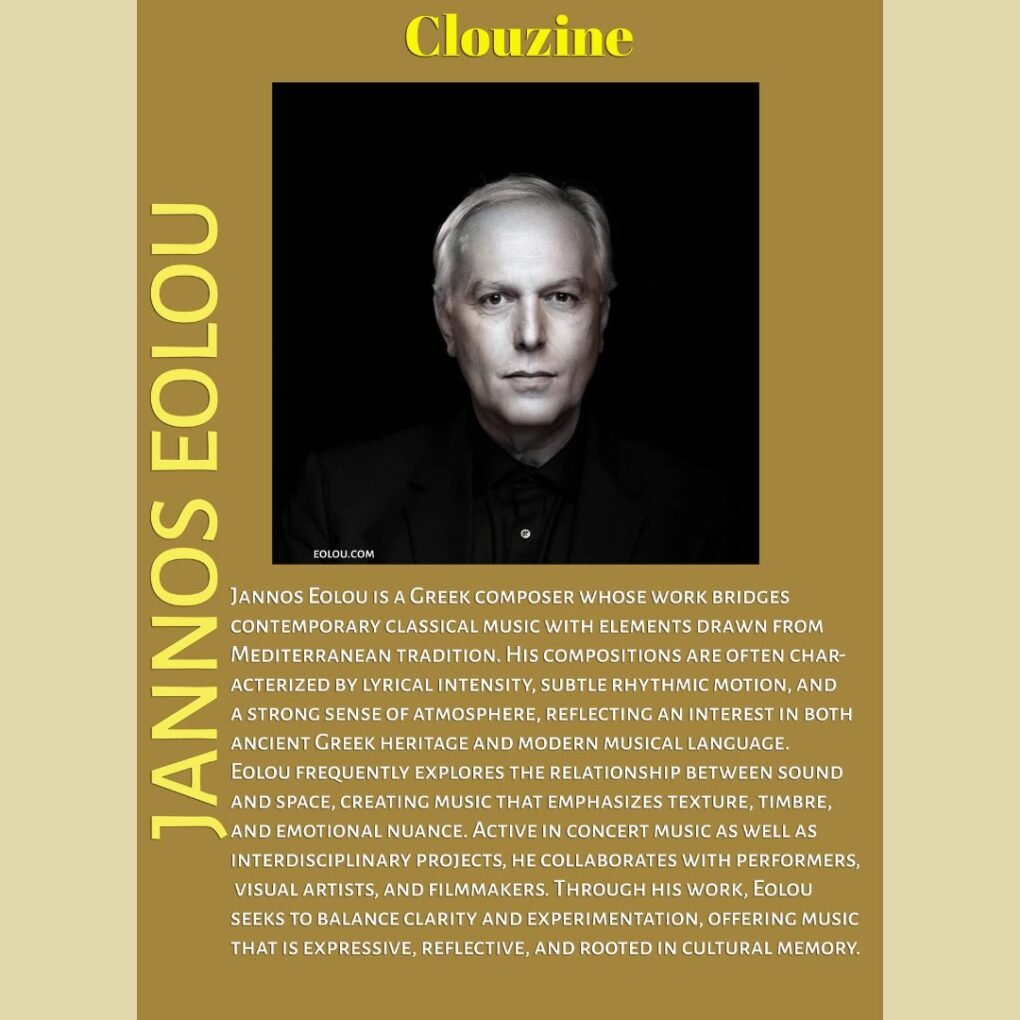
Reviews on NIGHT BEYOND
Night, in Jánnos Eolou's work, is never a backdrop: it is a mental territory, a space where emotions cease to speak and begin to vibrate. Entering Night Beyond is like pushing open a door without a handle. No fanfare, no grand, spectacular gestures. Just a silence that cracks, strings that emerge at breath level, and the immediate feeling that something intimate is unfolding, far from the world and its noise. Jánnos Eolou has created an orchestral album that eschews demonstration in favor of the slow, almost organic, infiltration of emotion. From the opening track, "Unwatched Stars ," the album establishes its aesthetic: a vast sky, yet devoid of any gaze to contemplate it. The strings float, suspended, as if less seeking to guide than to accompany a wandering. Nothing heroic, everything is restrained. The music moves forward with hushed steps, aware that fragility is its true strength. With Your Breath , Eolou gets closer to the body. The orchestral phrases almost mimic breathing, that vital mechanism we forget until it becomes palpable. It's a piece of unsettling gentleness, where each note seems to arise from a need rather than an intention. Kaleidoscope then fragments the sonic material. The motifs respond to each other, distort, and change emotional color without ever disrupting the balance. One thinks of an inner movement, of those nocturnal thoughts that constantly recompose themselves, unable to settle. More cinematic without being illustrative, Breakwater acts like a fragile dike against a turbulent inland sea. The low strings create a muted tension, while the high strings attempt to open a breach, a possible passage. Under the Same Sky brings a discreet, almost fraternal light. It is a piece that connects, that brings people together, as if the orchestra were whispering the idea of a shared humanity under the same invisible sky. The emotional heart of the album beats strongly on "Unwritten Letter" and "Due is the Night ." The former evokes what has never been said, the latter accepts darkness as a necessary debt. Here, Eolou excels in the art of suggestion without ever being heavy-handed, allowing the listener to project their own absences. The gravity becomes almost visceral in Requiem for a Smile , a deeply moving piece devoid of pathos, where grief is not dramatic but silent, dignified. Conversely, Your Hands reintroduces contact, human warmth, like a fragile yet sincere response. The album soars further with Perseids and Vortex , two expansive, almost cosmic movements where the strings trace trajectories, falls, and surges. Finally, Night in Pieces and After You Left close the cycle without a clear conclusion: the night fragments, absence remains, and the music accepts not resolving what cannot be resolved. Night Beyond is not an album to be consumed. It is a space to be inhabited. A work that never seeks to impress but which, through restraint and emotional precision, ultimately establishes itself as a rare experience: that of a night that listens as much as it speaks.
EXTRAVAFRENCH - FRANCE
In his new album, “Night Beyond”, Jánnos Eolou delivers one of his most virtuoso works Music is a conduit for charged emotions, whether painful or joyful. Music always finds a way to transform people. The award-winning musician and composer Jánnos Eolou has dedicated himself to this art for years, and his first album, "Dance of the Dead Roses" (1999), paved a prosperous path. With the internet still in its infancy in most countries of the world, Eolou distributed his art to an audience whose sensitivity stems from good musical taste. His main instruments, strings and piano, have managed over the years to showcase consistent, emotive, and intense works. This is the magic that follows. The creative process behind this Greek name found great inspiration for his second album, “Wintry Nostalgia” (2004). If in “Dance of the Road Roses,” its seventeen songs offer comfort from afar, in “Wintry Nostalgia” the pleasure of listening to its twenty-seven tracks is a true dream castle. However, this number paled in comparison to the playlist of “A Hero in Rome” (2006), with its no less than forty tracks. Other titles that followed, and therefore no less virtuous, definitively propelled this musical “architect” to a privileged place within his niche. Years later, and with a huge number of releases, certifications, and other achievements, Jánnos Eolou delivers his latest vessel of sonic poetry. Comprising thirteen tracks, the project is titled “Night Beyond,” a harmonious conglomeration made for string orchestra and other piano embellishments. The first song, “Unwatched Stars – String Orchestra,” already showcases the purity of this concept. Following that, “Your Breath – String Orchestra” introduces further introspection with sumptuous layers of violin. It's impossible not to be moved by such virtuosity, and these are just the first tracks of an album that, while classical, displays traces of modernity. As the title suggests, “Night Beyond” is a tribute to the night, that time of day that inspires so many musicians and poets. There’s a lot of poetry embedded in every chord here. Following the example we discussed in the last lines, Aeolus awakens your interest in philosophical poetry, while at the same time capturing your heart with beautiful melodic and symphonic lines that express his ideas. The cinematic power of this album's running theme is reflected in tracks like "Due is the Night", which causes sighs with the tension and anguish of its structure. It's no wonder that, in recent years, he has won awards such as "Best Composer", "Best Album", "Best Soundtrack", etc. As with "Requiem for a Smile", where various emotions are expressed in its structure, it's easy to see why Aeolou continues to receive more accolades. What many have already realized at this point is that the artist, in addition to showing influences from classical music, also has tango as a point of reference. His latest album, "Tangos Of the Magic Reality" (2023), consequently won many awards. Here in Brazil, in 2025, songs like "Perseids – String Orchestra", included in the current setlist, can expect even greater recognition. This recognition could be even broader, given the poetry contained in each musical note that makes the listener feel rather than just hear. Reflecting on another quote from Aeolus that says: “Although it changes very slowly, every night is different, unique, and although it seems timeless, it contains so much movement…”, you may find yourself listening to “Vortex”. However, the paths may lead you to “Night in Pieces”, which is more introspective. Finally, with “After You Left”, you may wake up from a trance and thank this Greek master for sharing the healing power of his compositions in the search for peace, tranquility and lightness.
MUSICFORALL.COM.BR – BRAZIL
From the very first notes of Night Beyond, Jannos Eolou invites listeners into a universe where night becomes both a sanctuary and a revelation. This 13-track album, blending modern Western film music with Mediterranean tonalities, is not just a collection of compositions; it is an exploration of the night as a living, breathing entity. Hailing from Thessaloniki, Greece, Eolou draws on over 25 years of experience in orchestration and composition to craft a work that feels at once intimate and cosmic, guiding audiences through shadows, starlight, and the hidden corridors of the human imagination. Each track in Night Beyond is a nocturne, masterfully composed for string orchestra, piano, and qanun. The music flows seamlessly between contemplative, almost ritualistic passages and dramatic, cinematic crescendos, allowing listeners to experience night as both fleeting and eternal. Tracks move effortlessly from hauntingly minimal passages to rich, cinematic sequences that conjure visions of starlight traveling across millennia, or dreams unfurling under an expansive sky.
Teeth Sound - USA
There’s something truly magical about Jánnos Eolou’s new album, Night Beyond. From the first notes, it’s clear that this isn’t just music, it’s an experience… What makes Night Beyond stand out is its seamless balance between tradition and modernity. The Mediterranean warmth of the Qanun adds a distinctive flavor, grounding the sweeping orchestral movements in a sense of place. The album flows naturally, moving from contemplative, almost meditative passages to moments of cinematic magnificence. It’s music that invites you to slow down and really listen, yet it also has a way of lifting you up, letting you feel the beauty and mystery of the night in every note… Listening to Night Beyond, you can’t help but feel connected to something larger—both the past and the future seem to exist in these 13 nocturnes… Night Beyond is a stunning achievement from a multiple award winning composer with decades of experience in film, theater, and orchestral music. It’s an album that rewards attentive listening, offering moments of beauty, emotion, and quiet awe. Whether you’re a longtime fan of Eolou’s work or locating him for the first time, this album is a charming journey into the magic of the night.
NUVAPULSE.COM – USA
Jánnos Eolou’s Night Beyond is a 13 track album for string orchestra, piano and qanun. It sits squarely in the space between modern film music and Mediterranean chamber writing, built around clear melodies and steady, song length nocturnes… The phrases could easily sit in a romance or coming of age drama. The phrasing stays clean and vocal, and Eolou’s experience in screen music comes through in how easy it is to follow the arc of the melody on a first listen… the album play like one extended meditation on nocturnes rather than a set of unrelated pieces… From a sync perspective, Night Beyond is a ready pool of cues for film and TV… The recurring qanun and tremolo plucked textures give it a regional identity, which could suit auteurs and series that want emotional clarity with a distinct Mediterranean accent.
Olivia - Cinematic Giants – USA
Night Beyond: Jannos Eolou and the Architecture of the Mediterranean Night. Throughout the album, night becomes a meeting point of layers of time—the ancient light of distant stars, the immediacy of the present moment, and the quiet pull of what is yet to come. This simultaneity gives Night Beyond its distinctive atmosphere… … the sound moves between cinematic breadth and intimate detail, often recalling the emotional language of modern Western film music... the qanun, played by Görkem Devrim Ökten, adds a distinctly Mediterranean timbre that anchors the album both geographically and culturally, bringing a sense of warmth and ancient continuity… there is a careful balance between composition and space, where stillness and resonance are as important as melody. Eolou's experience with film music, theater, and dance is evident in the composition and emotional clarity, but the music never remains illustrative. Instead, she invites personal interpretation and encourages the listener to experience the night in their own way. Composed over four years, Night Beyond feels like the result of prolonged contemplation rather than impulse. It is an album shaped by patience, experience, and openness—to the stars, to memory, and to what lies beyond the immediately observable. Ultimately, Night Beyond stands as a quiet yet powerful statement: a work that suggests that the night not only surrounds us but also lives within us, as deeply as we live within it.
VAN AAKSTER - De Ochtendschijn - HOLLAND
It's a true gem of neoclassical music… Jannos Eolou has created an impressive instrumental work based on a captivating string and orchestral arrangement. ‘Night Beyond’ embodies a cinematic feel and possesses a fabulous, soundtrack-like quality that is sure to enthrall. The album's overall richness, dynamic range, and dramatic energy, as well as its peaceful moments and meditative passages, make it incredibly diverse and dynamic.
Newindieradar.com – Germany
With ‘Night Beyond,’ the versatile and talented Greek composer Jannos Eolou offers an impressive album and a masterpiece of neoclassical music. Thirteen sophisticated arrangements of the highest caliber unfold, bringing the beauty of the string orchestra into sharp focus. A wide range of emotions, suspenseful, dramatic, and theatrical moments fill the room, while one can also interpret a certain euphoria, a sense of aspiration, and a spark of hope. The gentle romance and melancholy also contribute to a captivating listening experience. I certainly don't want to leave unmentioned the breathtaking precision and virtuosity with which the original figures and runs are set to music. I can promise you, there is truly a great deal to discover musically within the next 45 minutes!
BerlinOnAir - GERMANY
Jannos Eolou’s Night Beyond feels ancient and strikingly present… it becomes deeply immersive. Eolou does not explain what the listener should feel, nor does he dramatise the moment. Instead, he allows the music to hover in ambiguity, creating room for personal associations to emerge. The qanun’s presence becomes more noticeable in these moments, adding a delicate shimmer that feels distinctly Mediterranean without ever leaning on obvious stylistic tropes… There is a quiet universality in this section of the album, a reminder that night belongs to everyone, regardless of geography or circumstance. The Mediterranean influence is not presented as a cultural label but as an emotional temperature: warm, fluid, and gently resonant, like stone walls holding onto the day’s heat long after sunset. The emotional balance between melancholy and grace runs throughout Night Beyond and gives the album its enduring resonance. In “Your Hands” and “Perseids,” the album leans into intimacy and wonder. “Your Hands” feels close and tactile, as though the music itself is reaching out, while “Perseids” captures the fleeting beauty of a meteor shower with subtle surges and glimmers in the orchestration. These tracks highlight Eolou’s gift for translating natural phenomena into sound without imitation. Rather than mimicking falling stars, the music captures the feeling they leave behind: brief amazement, quiet joy, and the awareness of how small and connected we are beneath the vast sky. “Vortex” and “Night in Pieces” introduce a gentle sense of unrest. The harmonies become slightly more unsettled, reflecting the restless thoughts that often surface in the deepest hours of the night. Yet even here, Eolou resists chaos. The tension feels purposeful, controlled, as if acknowledging that uncertainty is a natural part of reflection rather than something to be feared. “After You Left” concludes the album with a sense of quiet resolution. It feels like the final moments before dawn, when the night begins to loosen its hold without fully disappearing. Night Beyond ultimately rewards patience and attentiveness, offering layers of meaning to those willing to listen deeply. In a world driven by noise and immediacy, Jannos Eolou has created an album that honors stillness, continuity, and the profound humanity of the night itself. –
Graham Peters, HITHARMONYHEAVEN - USA
A Waltz for Ghosts: Jánnos Eolou’s Haunting “Night Beyond There is a specific texture to darkness near the sea, a kind of humid weight that Jánnos Eolou captures with startling precision in “Night Beyond”. Listening to this album is like walking through a house you lived in twenty years ago: the floorboards creak in familiar places, but the furniture has been rearranged just enough to make you question your own memory. Eolou, a veteran composer with a cinematic pedigree including Solino, brings his command of the orchestra here, but it’s the inclusion of Görkem Devrim Ökten on the Qanun that acts as the narrative thread. In “Unwatched Stars,” the acoustic textures don’t just sit there; they percolate. It starts melancholic a solitary figure on a balcony but shifts into something with teeth, a driving rhythmic pulse that reminds me of the sensation of running late for a train you secretly hope to miss. It feels distinctly “widescreen,” yet oddly private. There is a moment in “Breakwater” where the fusion of Western orchestration and the almost crystalline logic of the Chinese melodic influence makes the air in the room feel thinner. It evokes the image of a koi pond viewed through frosted glass. The piano arpeggios ripple outward, mimicking water so effectively I found myself checking the window for rain. Speaking of rain, “Unwritten Letter” literally incorporates the sound of it alongside distant city mechanics. It’s a bold choice that anchors the high-register friction of the strings to something grimy and real, creating a waltz for ghosts navigating a wet pavement. The album explores the “Mediterranean Night,” but this isn’t a tourist brochure. In “Your Breath,” the strings vibrate with a mournful wobble, a heavy saudade that feels like finding a theater ticket stub in a coat you haven’t worn since winter. It is elegant, certainly, but it hurts a little. The Quarto Quartet & Deyan Velikov provide a string backdrop that swells like a chest taking in a sharp intake of breath. Then there is “After You Left.” If the earlier tracks were the contemplation, this is the panic. It channels a “Dark Academia” aesthetic sophisticated but frantic. It sounds like the realization that you’ve lost the plot of the novel you’re writing. The bowing is frantic, breathless, layering anxiety over beauty in a way that feels dangerously inevitable. Eolou has constructed a nocturnal philosophy here. It is music that treats the night not as an absence of light, but as a heavy, protective veil where time stops behaving linearly. “Night Beyond” suggests that the past and future are just sitting together at a table in the dark, waiting for you to pour the wine. Are you brave enough to join them?
Viviplay & Musicarenagh- GERMANY
Greek composer Jánnos Eolou has long been celebrated as one of the most accomplished and visionary voices in contemporary orchestral and cinematic music. With a decorated career that’s covered various disciplines and decades, his work reflects an incredible ability to bring together classical stylings with emotional storytelling which has earned him acclaim both in his native Greece and across Europe. A composer, educator and creative thinker, his music moves between the spheres of theatre, dance, film and concert stages, revealing an artist who treats sound as a living form of expression. Having studied in both the UK and the USA, Jannos’ musical outlook is truly international; his early years were spent composing for theatre and modern dance before he found his way into cinema, a turning point that saw him collaborate with the acclaimed German-Turkish director Fatih Akin on the film Solino. Released by BMG Germany, the soundtrack became a breakthrough moment, receiving widespread critical praise and maintaining a place among the top 40 most popular soundtracks on Amazon Germany for nearly two years. It was an achievement that placed Jannos firmly on the European musical map. Over the years, his collaborations have spanned a vast creative spectrum, working with renowned Greek artists such as Giorgos Dalaras, Yannis Kotsiras and Eleni Tsaligopoulou, alongside international creatives including Klaas Bense and Claudio Bernardo. His music has been performed by symphony orchestras across Germany, Italy, Belgium, the Netherlands, the Czech Republic, Israel and Turkey, reflecting the universal quality of his compositions as music that transcends language through emotional context and atmospheric beauty. His film work continued to earn accolades, most notably for To Tango Ton Hristougennon (Christmas Tango), whose score brought him two Best Film Score Awards in 2012 from the Hellenic Film Academy and the Sever Art Awards. The project confirmed his place as one of Greece’s leading cinematic composers, while his later opus Tangos of the Magic Reality further enhanced his reputation on the world stage. The album secured a string of international honours, including four Platinum Awards from the LIT Music Talent International Awards in 2023 and the Best Instrumental Album at the Clouzine International Music Awards, recognition that underlined the timeless, cross-cultural appeal of his work. Now, Jánnos Eolou unveils Night Beyond, a thirteen-track orchestral album that stands as one of his most personal and conceptually ambitious works thus far. Composed over the past four years, it’s a meditation on the nature of night, not merely as a physical phenomenon but as a philosophical and spiritual state. Thematically, the album explores this temporal and emotional fluidity, treating night as both a veil and a mirror, something that conceals, protects and ultimately reveals. Night Beyond was recorded with a stunning ensemble of musicians, featuring the Quarto Quartet and Deyan Velikov, who layered their performances to create the expansive sound of a full string orchestra. Turkish musician Görkem Devrim Ökten brings the ethereal tones of the qanun, adding an Eastern texture to the record, while Jannos himself performs on piano. From the dramatic and subtle tension of opening piece “Unwatched Stars,” the album flows with steady piano performance and the dazzling impact of stacked strings, carrying Jannos’ stunning compositions with grace and panache. Songs like “Your Breath” flow with sweeping melodic lines and a soft sense of melancholy while “Breakwater” adds flashes of qanun to furnish the music with playful moments. “Your Hands” casts an enchanting musical spell of alluring melodic writing and wholly absorbing arrangement. The album closes with “After You Left,” delivering a spectacular listening experience brimming with theatrical energy and packed with twists and turns, offering a sensational finale to Jannos Eolou’s truly astonishing new musical work.
Plastic Mag - UK
Night Beyond rewards patience and attentiveness, offering layers of meaning to those willing to listen deeply. In a world driven by noise and immediacy, Jannos Eolou has created an album that honours stillness, continuity, and the profound humanity of the night itself.
Hit Harmony Heaven - USA
Melodies float like half-remembered dreams, never settling on a definitive meaning. Tenderness, longing, and quiet wonder emerge and disappear without intruding, leaving room for personal interpretation. … "Night Beyond" feels less like an ending than a gentle letting go. A quiet echo lingers, comparable to the feeling of standing alone just before dawn. Eolou demonstrates a rare faith in the power of restraint, creating a work that values silence as much as sound.
MUSICGALAXY – GERMANY
This album is a complete journey through space and our thoughts; it leaves us captivated, involved, and completely moved. A beautiful and vigorous work that leaves us speechless; we absolutely loved it... it is magnificent, intense, grandiose, it makes us feel blood rushing through our veins, it has emotion and many vibrations, it has the ability to make us hallucinate, face our emotions head-on, put them all on the table and overcome them, a track that has tension and brings sounds that put us in suspense and also in relaxation, this track left us with many reflections and very emotional.
Victor Matheus – IndieClock – BRAZIL
In 2023, Jánnos Eolou released Tangos of the Magic Reality to much acclaim, including from us. “I guarantee you won’t have heard tangos like these before,” I said in my review. Now, as we tick over into 2026, the Greek composer has returned with Night Beyond, thirteen compositions full of nocturnal drama, underpinned by folk heritage and making classical music cinematic and contemporary. Each piece is infused with subtle philosophy and storytelling, reflecting on ideas of the unknown, divinity and the cosmic. Under the Same Sky is a standout moment, embodying this ideal in every stirring note. If you love neoclassical and cinematic music, then Night Beyond is a must listen. The album is out now, and you can give it a listen below.
Graeme Smith York Calling UK
Night Beyond Is A Masterfully Crafted Album Where Jannos Eolou Channels Over 25 years Of Musical Expertise Into An Evocative Exploration Of The Night, Blending Neoclassical Sophistication With Mediterranean Textures And Cinematic Sensibilities Ultimately, “Night Beyond” is both a meditation on the night and a testament to Eolou’s mastery of musical storytelling, blending neoclassical orchestration, Mediterranean textures, and cinematic sensibilities to create an emotionally rich and intellectually engaging experience. It is an album that celebrates the ephemeral, the eternal, and the sublime, translating the nocturnal Mediterranean world into sound with extraordinary precision and imagination… it is an immersive journey that solidifies Jannos Eolou’s position as a composer of profound depth, capable of crafting music that resonates across cultures, time, and space.
DULAXI - USA
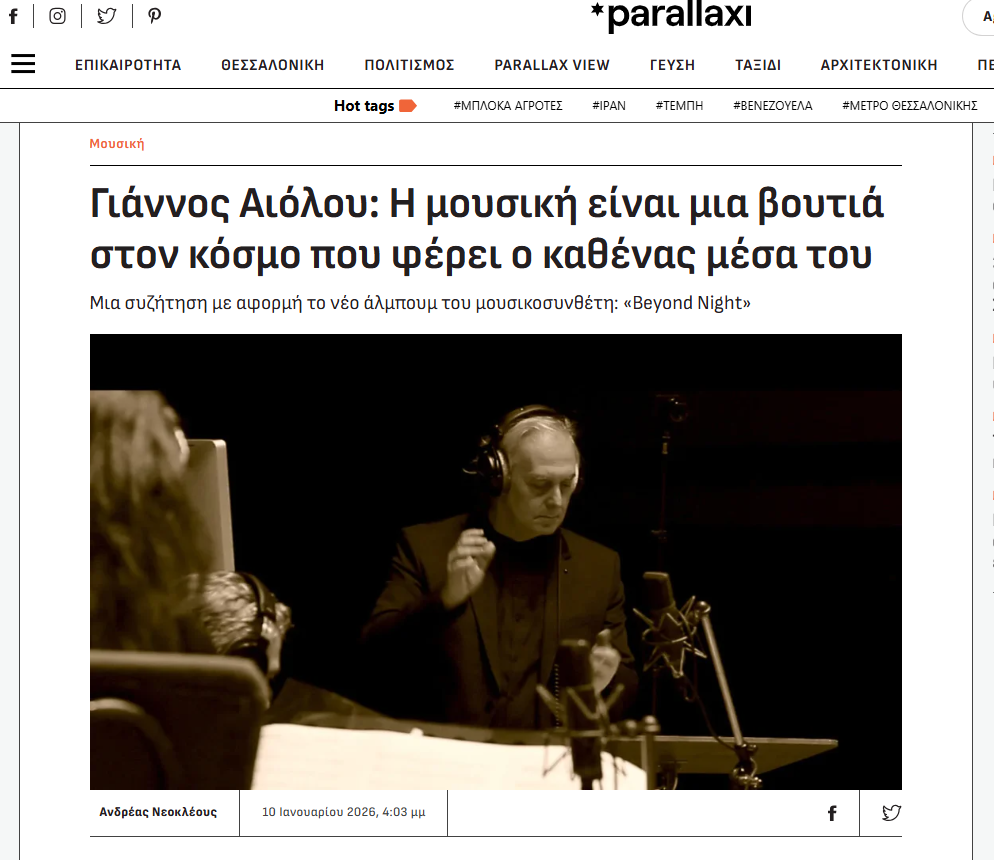
*parallaxi mag – INTERVIEW ON THE ALBUM ‘NIGHT BEYOND’
Jánnos Eolou: Music is a dive into the world that everyone carries within themselves.
A discussion on the occasion of the composer’s new album: “Beyond Night”
Andreas Neokleous – January 10th 2026, 4:03pm
I imagine there is always an awkwardness when, within a phrase or sentence, one tries to describe something one has just heard – and perhaps even more so when that “something” does not belong to language, but to music. When it comes to a composition that resonates in such an open and uncharted context as the night, the words seem to lag or rather follow from a distance.
My first encounter with Jánnos Eolou was through film: the soundtrack of the film that was an adaptation of “Christmas Tango” to the big screen, in the not-so-distant 2011. I feel that there, his score functioned almost like a cavalier: discreet but present, it led the drama without overshadowing it.
However, this is the first time I’ve listened to his work in that way: on his own personal album, “Beyond Night” (2025), where instead of following the “emotional conditions” that might pre-exist in a film, He immerses himself in his inner documents, trying to understand them and distill his own musical universes.
Just as Umberto Eco proposes the idea of “multiple reading”, so I followed the multiple listening of his musical compositions – this is how
the following questions arise that you will see being asked.
On a personal note, ‘Night Beyond’ is not just a title, but an attitude: an insistence on staying in the night without dramatizing it and listening to it without using it as an alibi. Somewhere along these lines the questions that permeate the creative process — not only of music, but of all art that is exhibited, arose.
On the occasion of the new album, our conversation for the Parallaxi magazine started, with this precise delicate balance:
There is Basquiat’s view that music does not decorate space, but time. Listening to “Night Beyond”, one feels that time does not flow in a straight line, but it is transformed. If I asked you to stand as a listener to your own work: would you say that this relationship with time concerns you?
Perhaps Basquiat wanted a contrast to painting, which was his art, and resorted to his statement that music decorates time and not space.
Music is one of the few artforms that has time structurally interwoven into its expression, and has rhythm as a structural component.
But my own view is that art does not ‘decorate’ anything. It should not have that use or logic. For me, music is a dive as deep as anyone can into the world they carry within themselves – a contact, perhaps a conversation, with the structural component of life, which transcends the senses, transcends the cognitive, the logical.
It is a relationship with what creates us, with what we are made of.
Time is a human invention, and of course it has a rhythm, a way of measuring,
perhaps even a beginning, all combined with the observer… changing the way
we observe, we change time…
The movement of the universe – and of the night, to connect it to my latest work – is a movement in space, in time, in energy, in dimensions much more than 3 or 4.
The magic exerted by the darkness of the night, which is ‘torn’ by the celestial movement of the planets and stars, is precisely because there, we recognize something that we have always known, but which we do not yet have the tools to describe… The universe, as of course you know, is much more than what telescopes and our eyes see… These things that we ‘don’t see’ but ‘recognize’ are, I think, the starting point of my work and perhaps the main reason for the night’s fascination for all of us…
Is this logic of subtle shifts — where the universe changes without interrupting the flow — something that is core to you as a composer? As if magical realism is not just a reference or a technique if I may say so in your work, but a fundamental way in which you perceive and organize your music. Is that true?
I have said it before that the process of composing the Tangos of Magic Reality – which initially lasted a decade but it still continues, is not over – has changed and shaped me as a person and as a composer. What you claim is true. The sense of ‘truth’, of realism, changes when the angle of view, of observation, changes, and the incorporation of many ‘slightly changed’ frames of view – or listening – illuminates the same content differently, and this gives me the possibility of a clearer sense of it, and a knowledge that does not rest on possibly false certainties, but which, since it goes beyond the framework of observation, can perhaps approach the very essence of the content a little better.
It is certainly not just a technique. I could teach the technique or have someone imitate it, but believe me, there is no ‘one way’. That is why there is no ‘one reality’, no ‘one truth’, no ‘one line to follow’, but a ‘cloud of possibilities’, within which the possibilities of the evolution of musical writing are activated almost as a matter of course, as if the movement were the sum of dozens of spiral movements, with very different centers, but which all have a starting point, my psyche.
What each listener receives also puts their own centers into the equation.
And this can be even more interesting to anyone who wants to let themselves be moved by the musical movement.
“Night Beyond” feels less like a collection of tracks and more like a single nocturnal journey. Did the idea for the album emerge from the beginning as a comprehensive project, or did it form gradually, through individual compositions that later “asked” to coexist?
Musical themes exist in this ‘cloud of possibilities’ that I told you about above. How they meet us, on what grounds… it is impossible to describe.
There are the ‘conditions’ in which my psyche lives, reacts… and the musical themes meet me there without dialogue, directly. The outcome of any encounter is recorded… sometimes… and then I may recognize some of the messages they bring to me… other times, I recognize things much later.
Certainly, mental and temporal coherence usually results in musical works that have an ‘affinity’, as a progression, continuity or wholeness.
But when we talk about works that are not ‘commissioned’, like the music of a film, let’s say – where the ’emotional conditions’ pre-exist and you simply encounter them – in works that are born purely from the composer’s inner voice, then the processes are roughly as I described them to you… that is: you just dive in… at some point you understand… maybe…
The choice of a string orchestra, without any showmanship or “grand gestures”, gives the album a sense of breath and intimacy. What led you to this particular sound? Was it an aesthetic need, a narrative choice or a more instinctive decision?
I am not interested in aesthetics as an end in itself. I am only interested in them as a link of coherence in a narrative language. Instinct plays a big role, of course, but to describe it to you in perhaps more understandable terms, I would tell you to think of the orchestra and the individual solo instruments as a selection of characters in a literary or theatrical work.
When the author creates his characters (in my case, choosing the instruments) he slowly lets himself be drawn into the relationships that the characters create with each other, depending on their past, their passions, he becomes more of an ‘observer’ of musical relationships – from there comes my desire to modify my perspective to test my characters (musical but also personal ones, probably), and to create ‘universes’ where many relationships are possible, to surprise me, but not for the sole purpose of impressing me… to shake me, make me understand what lies ‘behind the shadow’, what is causing the shadow, or what life would be like only in the shadow or even without it… so how I illuminate my musical themes (how I observe them), sometimes it is as important as the musical texts themselves, which are largely determined by the way my characters (i.e. the instruments) themselves interact.
I usually create group ‘situations’… that is, beyond the capabilities of the instruments and performers themselves (e.g. the first violin can play much faster themes than the viola or double bass, or the piano can play melodically, add color, rhythm, or even counterpoint… the natural limits that all composers know) I try to create harmonious landscapes where the sum of the musical voices ‘implies connections’ that are not obvious, like an aftertaste from an ingredient that you don’t immediately recognize with the first bite, but it is characteristic…
Listening to the album, I have the feeling that the Qanun always appears discreetly, not to be a soloists, but to subtly change the emotional temperature of the sound. How do you perceive the role of this instrument within the entirety of your compositions?
The Qanun is an ancient instrument that carries many aromas. It is the main instrument of many musical traditions. For me it is a quintessentially Mediterranean instrument. It is identified with the modal sound – the sound of the modes – not the Western one, I mean.
In my work, I wanted its musical aromas and not so much its ‘musical style’. I wasn’t interested in the makams, that is, because I was incorporating it into a vertical, Western, harmonically complex composition where it had to have a very specific space to coexist with the whole.
In general, I’m not that interested in the ‘traditional’ way of improvisation where each instrumentalist (or dancer, to look at it from the audience’s perspective) comes and presents their own version while the rest sit on the sidelines and applaud.
I am interested in an ensemble that, like an orchestra, like a ballet, like a clock mechanism, perceives time in common.
So, I composed parts for the Qanun that could theoretically be played by a Western orchestral instrument, e.g. a harp, or a piano… but the result would not be the same because the Qanun has a language emotionally charged with the Mediterranean space, the honeyed aura of the Mediterranean night. The Qanun plays with the Western view of the musical text, all written and measured with absolute precision, but with its own voice, its own aroma…
Listening to the album over and over again, I feel that each passage brings new details, small shifts in the sound, like a book that reveals pieces of itself each time. Do you agree with the idea of a “multiple listening” like the one Umberto Eco suggests for books? Would you say that the album benefits from this process?
It is so self-evident to me… to the point that I would tell you that if I believed that ‘multiple listening’ or the need for it did not exist, I would have no reason to do what I do. Each musical theme can occupy me for many weeks or months. I listen to it, sculpt it, erase it and rewrite it dozens of times. Imagine if I ‘listened’ to the same theme every time… I wouldn’t be able to continue…
The way music is composed (like the one I serve) could not but have many levels of reading – listening. And I don’t just mean that since there are many voices you sometimes go beyond the first, second voice and you discover and the innermost…
I mean all those suggestive phrases, the broken harmonies that can be analyzed in many ways, the ambiguous musical situations in which my musical heroes (the instruments) enter the universes that I expose them to, particularly changing the position of observation each time… so each time it is a little different, as the language becomes more familiar, as the musical phrase becomes part of each of us… and as we change as listeners, it is important that there is always space within the work to meet us in the new version of ourselves…
The night, as a thematic field, in “Night Beyond” seems to create a freer, more participatory space, different from the limited world that cinematic music with images can potentially evoke. Do you feel that this openness helps the listener experience “empathy”?
In film music, my music, in addition to serving each scene, developing and elevating it emotionally, also tries to function on a second level as another form of narration, a parallel narration, which could potentially exist on its own.
This can sometimes be limited by the film itself.
In the works that I create from the beginning (which since 2015 are more and more and I confess that I need them more) I do not have the narrow framework of the film’s image. This on the one hand makes this kind of music less accessible to the uninitiated audience – when they don’t have an image to let their imagination rest on and feel in tune with what they are receiving overall – But for those who follow me on my musical journey, the freedom is much greater because it is the audience’s images, their own thoughts, anxieties, desires that enter as part of the narrative, the identification, the ’empathy’ as you say.
Night is a canvas that, just as I said above, makes us ‘recognize’ universes from which we come, as if from always… These emotional spaces to which darkness exposes us are certainly much larger than what our logic or imagination can contain. We can only feel them. Not think about them or describe them.
Music is one of the primordial languages that our cells recognize and thus somehow tune in to our origins, the darkness, the womb, the afterlife…
https://parallaximag.gr/agenda-parallaxi/mousiki/giannos-aioloy-i-moysiki-einai-mia-voytia-ston-kosmo-poy-ferei-o-kathenas-mesa-toy
Reviews on TANGOS OF THE MAGIC REALITY
‘…Jánnos Eolou transferred the tango feeling to his compositions with a constant transformation of tonality, melodies and of course orchestrations. He combined the restrained sadness and "underground" melancholy of tango with the seductive quality of magical realism to present multiple alternative views of the surrounding world in his "Tangos Of Magical Realism" Jánnos Eolou, based on an idiom of the past, submitted a most atmospheric contemporary work of genuine beauty and high aesthetics that deserve to be enjoyed…’
Thanos Mantzanas – 3rd Program, Greek National Radio ERT - Classic Radio
‘…Jánnos Eolou offers us a true masterpiece with his album “Tangos of the Magic Reality”. This epic project stands out for its cinematic arrangements and grandiose instrumentation. Each of the instrumental pieces transports the listener into a world of beauty and poetry. This unique opus skillfully combines tradition and modernity. The haunting melodies and bold harmonies captivate the ear, creating an immersive musical experience...’
Indiechronique.fr
‘…I guarantee you won’t have heard tangos like these before… There’s such a wonderful sense of adventure that burns right through Tangos Of The Magical Reality. Jánnos knows how to breath life into his compositions and they are beautifully realised by the orchestra…’ -
Graeme Smith Yorkcalling.co.uk
The new album "Tangos of The Magic Reality" is very elegant, it brings a sonic magic in our ears, diverse and varied feelings, a suggestive and subjective work, which can communicate with anyone for being timeless…’
Victor Matheus (Brazil) IndieClock.Com.Br
‘… There is a complete sound here, rich and dynamic, symphonic in a few words. Jánnos Eolou creates compositions pf a lyrical and at the same time epic context, with a somewhat cinematic perspective… with melodic moments, truly special, that could immediately become a "hit"…’
Fontas Troussas – Diskorihion (Music Critic Magazine)
'...It is an album with 18 compositions, full of melodic and harmonic richness, which sounds surprisingly modern and classic at the same time. One of the best - if not the best - releases of 2023...'
Michalis Tsantilas Mixgrill.gr
‘…“Long Summer Shadows,” a vibrant piece that sets the tone with its lively staccato rhythms and playful orchestral arrangement… “Maze” dazzles with its grand melodic leads… “Star Necklace” soars with its powerful lines and emphatic arrangement… “Elysee” exudes urgency, with brooding bass strings and striking lead flourishes… “Peacock” delights with its rich sound and poignant writing… With its rich textures, dynamic compositions, and masterful performances, Tangos of the Magic Reality is a sensational showcase of Jánnos Eolou’s artistic talent and his ability to transport listeners to a realm where music becomes an immersive and transformative journey…’
Plastic.CO.UK Magazine)
‘…Amazing tangos, combining Astor Piazzolla's nuevo tango with contemporary film music, with a personal language! Listening to the lyrical, soulful "Panther" with its staccato melodies, unexpected trills and harmonic chains, one travels to old Argentine tangos by Villoldo, Alcorta and Gardel, with a cinematic aesthetic (as we came to know through Piazzolla's music) transferred to today... Hail to Jánnos Eolou’
Renata Dalianoudi, Music Critic
Reviews on CHRISTMAS TANGO SOUNDTRACK
‘…the music is incredibly accurate, serious and essential to the film. The main vehicle that moves the whole soundtrack is a dramatic music theme that acts like the 'voice of destiny'. Sometimes lonely, reluctant and shy, expressive, revealing, discrete, emotional, urgently dramatic, introvert... different shapes that prove the composer's ability to mold the same music theme according to the needs of each scene within the film. Above all, we see the mastery of the composer to identify the film's musical signature so successfully from the first moment. This is one of the most vital things for a film, and in this particular case, the composer was really inspired when composing the main themes which dominate the whole soundtrack…’
(Soundtrackbeat.com)
‘…for the first time in Greece Music and Cinema have joined forces in such a way, leaving the audience breathless...’
Nikolas Aronis, Zougla.gr
‘…music is the key aspect of the film...' -
Yiannis Zouboulakis, Vima Newspaper
‘…sensational music…’
Lifo
‘… the extraordinary Jánnos Eolou composed a soundtrack of the highest standards that works as a catalyst in the film from the first moment. Its big success is that it is a work of art and can be enjoyed also outside the film. It is a one of the best music works we came across for a long time now. It is of Hollywood standards.’
Yiannis Theodosiadis (BizzNews)
‘…the soundtrack starts with the 'song version' of the main theme (lyrics by Eleni Zioga), performed by Giorgos Dalaras – with the enchantment of a heavy emotional but also controlled performance. Then 39 more tango instrumental versions of the 3 main themes follow, of rare beauty and elegiac power. Finesse, bittersweet melancholy and an esoteric tension in a monumental work by Jánnos Eolou…’
Jazz & Jazz
‘… musical grandeur…’
Panagiotis Timogiannakis
‘…the music was fantastic... a film created by real artists…’
Michalis Reppas (Real News)
Reviews on LA FORET DES VOEUX
‘… The best music work I have heard in 2019…’
Panos Chrisostomou, 2nd Program, Greek National Radio ERT
‘…The audience left the premises enchanted... in another universe…’
Thessalia TV